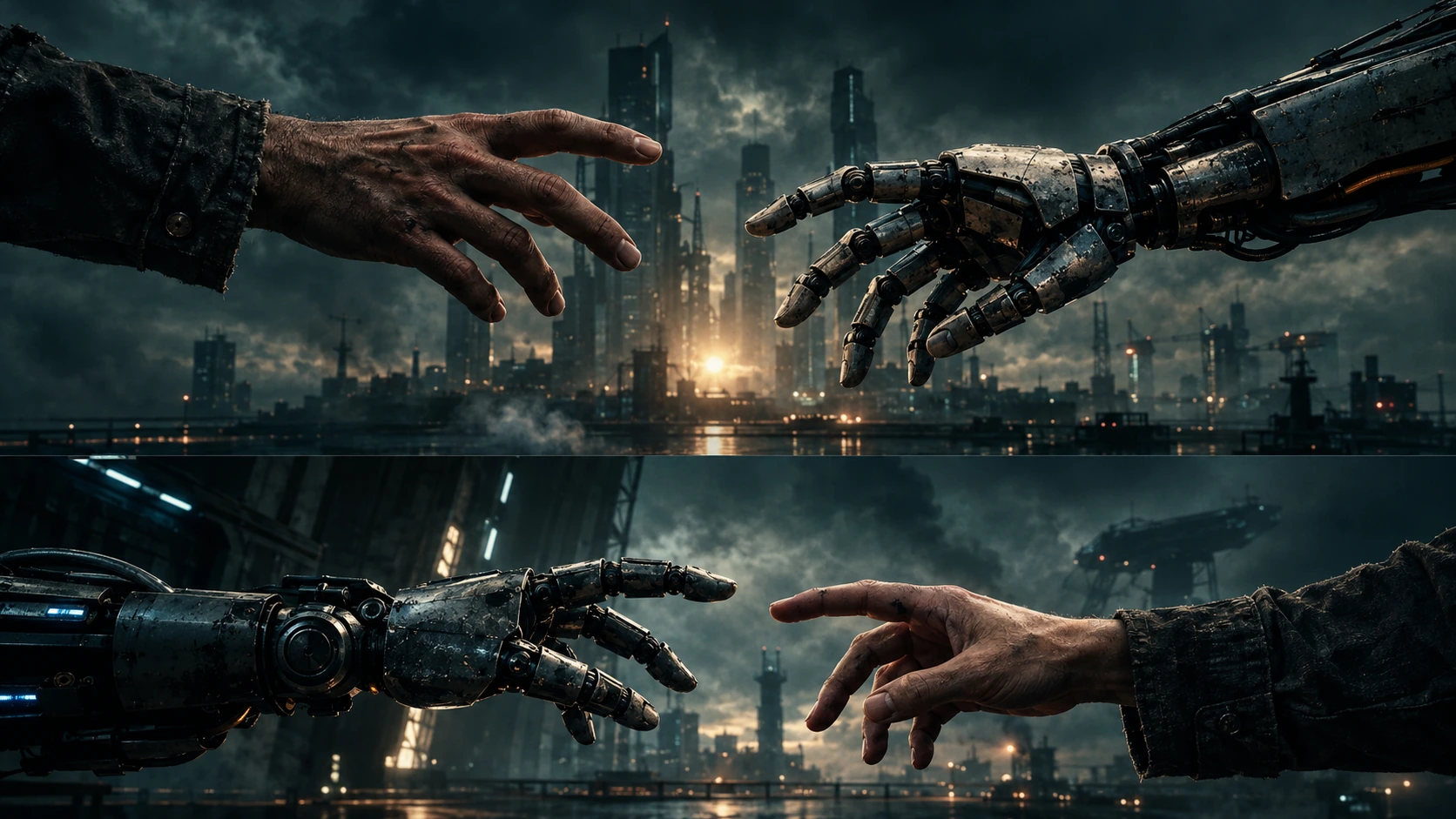
AI, or artificial intelligence, is technology that enables computers to perform tasks that normally require forms of human intelligence. Those tasks can include understanding language, recognizing patterns in images, predicting likely outcomes, generating text or pictures, translating speech, recommending content, and making decisions from data.
That definition is broad because AI is not one single machine or program. It is an umbrella term for many techniques and systems. Some AI is built for one narrow task, such as detecting spam. Other systems can work across many kinds of information and respond to open-ended instructions. The important idea is that an AI system uses computational methods to produce an output that would traditionally have required human judgment, perception, language, or pattern recognition.
If you are asking what is AI in simple words?, a useful way to think about it is this: people give computers examples, data, rules, goals, or feedback, and the system uses what it has learned to recognize patterns and produce useful responses. It does not mean the computer thinks exactly like a person.
What Does AI Actually Mean?
The term artificial intelligence covers a large area of computer science concerned with building systems capable of tasks associated with intelligence. The field includes machine learning, natural-language processing, computer vision, robotics, planning, reasoning, and generative AI.
A calculator is excellent at arithmetic, but we normally would not call ordinary calculator functions AI. A system that can examine thousands of examples, identify patterns, and then classify a new image or generate a new response is closer to what people mean when they talk about modern AI.
For a broader historical and technical overview, the Artificial intelligence article on Wikipedia provides background on the field, its history, approaches, and terminology.
What Is AI in Simple Words?
Imagine showing a computer a very large number of examples and giving it a way to learn relationships inside those examples. After training, you can give the system something new and ask it to make a prediction or produce an answer based on patterns it learned.
For example, an image model can learn visual relationships from training data and later generate a new image from a written prompt. A language model can learn statistical relationships in language and then generate text in response to instructions. A recommendation system can study behavior and estimate which movie, product, or song a person may want next.
The details behind these systems can be highly technical, but the basic idea is approachable: AI systems use data and mathematical models to find useful patterns and apply them to new inputs.
How Does AI Work?
There is no single process used by every AI system. A common modern approach is machine learning, where a model improves at a task by learning patterns from data rather than relying only on hand-written rules.
Training
During training, a model is exposed to data and adjusts internal numerical parameters. The exact process depends on the type of system. The objective may be to predict a missing word, distinguish one category from another, estimate a value, or learn relationships between text and images.
Inference
After training, the model can be used on new inputs. This stage is often called inference. When you enter a prompt into a generative AI service, the trained model processes that input and produces an output based on patterns encoded during training and the instructions it receives.
Feedback and improvement
Developers may evaluate model outputs, improve data, adjust training methods, add safety systems, or use human and automated feedback to improve later versions. That does not mean every individual AI system automatically learns everything you tell it in real time.
What Is Machine Learning, and Is It the Same as AI?
AI and machine learning are related, but they are not identical terms. Artificial intelligence is the broader field. Machine learning is one major approach used to create AI systems.
Traditional software often follows explicit instructions written by programmers. Machine-learning systems can instead learn useful patterns from examples. Deep learning is a further area of machine learning that uses neural networks with many computational layers and has played a major role in recent advances in language, vision, audio, and generative media.
So when someone asks “what is AI and machine learning?”, the simplest distinction is: AI describes the broader goal of creating intelligent computer behavior, while machine learning describes a set of methods that can help achieve that goal.
What Is AI Really Used For?
AI already appears in many ordinary products and professional workflows. Search systems use it to understand queries and rank information. Email services use automated systems to identify spam. Maps can estimate traffic and travel times. Banks use automated models in fraud detection. Cameras can recognize scenes and improve photographs. Accessibility tools can transcribe speech and describe visual information.
Generative AI has made the technology more visible because people can directly ask systems to create or transform content. Today, AI tools can help draft text, generate images, create video, synthesize speech, assist with software development, summarize information, and explore creative concepts.
AI is also used in science, manufacturing, logistics, cybersecurity, healthcare research, customer service, education, and many other fields. The capabilities and reliability vary substantially by system and use case, so human review remains important, especially when mistakes can have serious consequences.
What Is Generative AI?
Generative AI refers to models designed to produce new content. Depending on the model, that content can be text, images, audio, video, code, 3D information, or combinations of several media types.
The user typically provides an instruction called a prompt. The quality of the result depends on many factors: the model, the prompt, available controls, training, generation settings, and sometimes reference media. Prompting is therefore less like giving a computer a magic phrase and more like communicating creative or practical direction to a system with particular strengths and limitations.
This is where my work on O4Prompts and OrigaStock connects naturally to AI. The site focuses on visual prompting and creative direction rather than trying to redefine artificial intelligence itself. Tools such as Cinematic Shots, Composition Lab, and Video Prompt Builder are designed to help creators think more deliberately about shots, composition, camera direction, color, and the language they give to generative tools.
I see prompt building as one practical layer of working with generative AI: the technology provides the model, while the creator still brings the idea, taste, references, judgment, and decisions. O4Prompts is intended to support that creative process without pretending that a prompt replaces the person making those choices.
Is AI the Same as a Human Mind?
No. Modern AI can perform some tasks at remarkable speed and scale, but that does not mean it has the same kind of understanding, experience, intention, or general judgment as a human being.
A language model can generate a fluent explanation and still make a factual mistake. An image model can produce a visually impressive scene while misunderstanding spatial relationships or a specific instruction. AI output should therefore be evaluated rather than assumed to be correct simply because it sounds confident or looks polished.
What Is an AI Agent?
An AI agent generally refers to a system that can use an AI model as part of a process for pursuing a goal, often by taking multiple steps and interacting with tools, software, or information sources. Instead of producing only one response, an agentic system may plan an action, use a tool, inspect the result, and continue.
The term is used broadly, so products described as “AI agents” can differ considerably. Some are sophisticated automated workflows; others give a model access to tools and allow it to choose among actions. The useful question is not only whether something is called an agent, but what actions it can actually take and how much human oversight remains.
What Is AI Automation?
AI automation combines automated workflows with AI capabilities. Traditional automation is usually predictable: when a defined event occurs, the software performs a predefined action. Adding AI can make parts of that workflow more flexible, such as classifying an incoming request, extracting information, summarizing text, or deciding which predefined path should run next.
For businesses and creators, the value is often not “replacing everything with AI.” It is reducing repetitive work while keeping people involved where context, taste, accountability, or judgment matters.
Who Created AI?
Artificial intelligence was not invented by one person. It developed through the work of many mathematicians, computer scientists, engineers, cognitive scientists, and researchers over decades.
Alan Turing's early work on computation and machine intelligence became foundational to later discussion. The term “artificial intelligence” is commonly associated with John McCarthy and the 1956 Dartmouth workshop, an important event in establishing AI as a research field. Researchers including Marvin Minsky, Claude Shannon, Allen Newell, Herbert Simon, and many others contributed to its early development and later branches.
For that reason, phrases such as “the father of AI” are oversimplifications. They can refer to different historical figures depending on the contribution being discussed.
How Do You Explain AI to a Beginner?
Start with what AI does rather than with complex mathematics. AI is a set of technologies that allows computers to perform certain tasks involving patterns, language, perception, prediction, or generation. Many modern systems learn those patterns from large amounts of data.
Then remember three limits. AI is not automatically correct. Different AI systems are designed for different jobs. And human decisions still matter: people choose the goals, tools, data, prompts, constraints, and ways outputs are used.
That is enough to understand the foundation. From there, topics such as machine learning, neural networks, generative AI, agents, computer vision, and language models become easier to explore without treating “AI” as one mysterious technology.
Frequently Asked Questions About AI
What is AI in simple words?
AI is technology that lets computers perform tasks involving abilities such as recognizing patterns, understanding language, making predictions, or generating content.
What is AI and how does it work?
AI is a broad field. Many modern AI systems use machine learning: models learn patterns from data during training and then apply those patterns to new inputs during inference.
What is AI really used for?
AI is used for search, recommendations, fraud detection, translation, accessibility, image and speech recognition, software assistance, generative media, research, automation, and many other applications.
What is the difference between AI and machine learning?
AI is the broader field of creating computer systems that perform intelligent tasks. Machine learning is one family of techniques used to build many modern AI systems.
What is an AI agent?
An AI agent is generally a system that uses AI to pursue a goal through multiple steps, often with access to tools or software actions. The exact capabilities depend on the product.
Who created AI?
No single person created AI. The field grew from decades of work by many researchers. John McCarthy is strongly associated with the term “artificial intelligence,” while figures such as Alan Turing made important earlier contributions to thinking about machine intelligence.